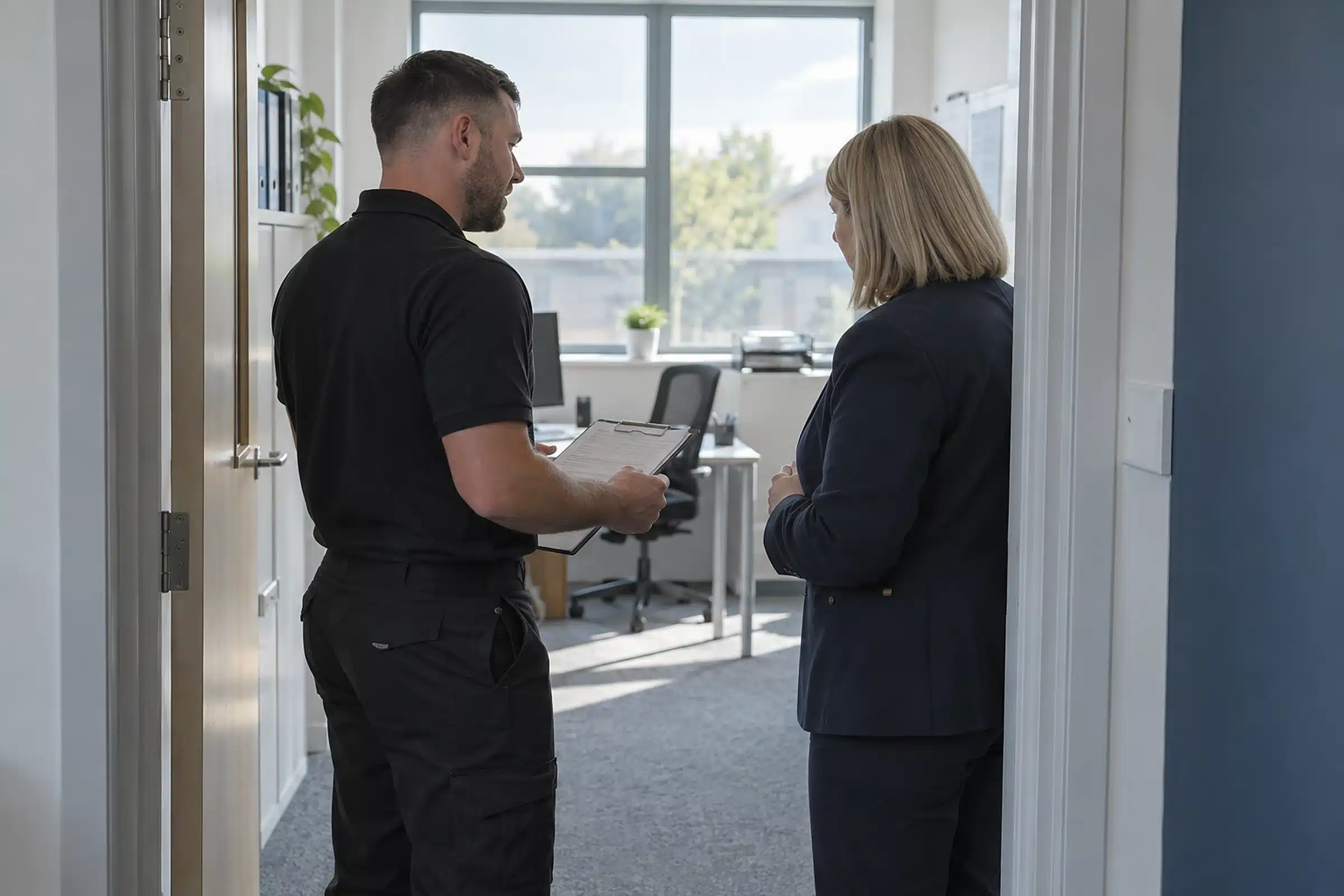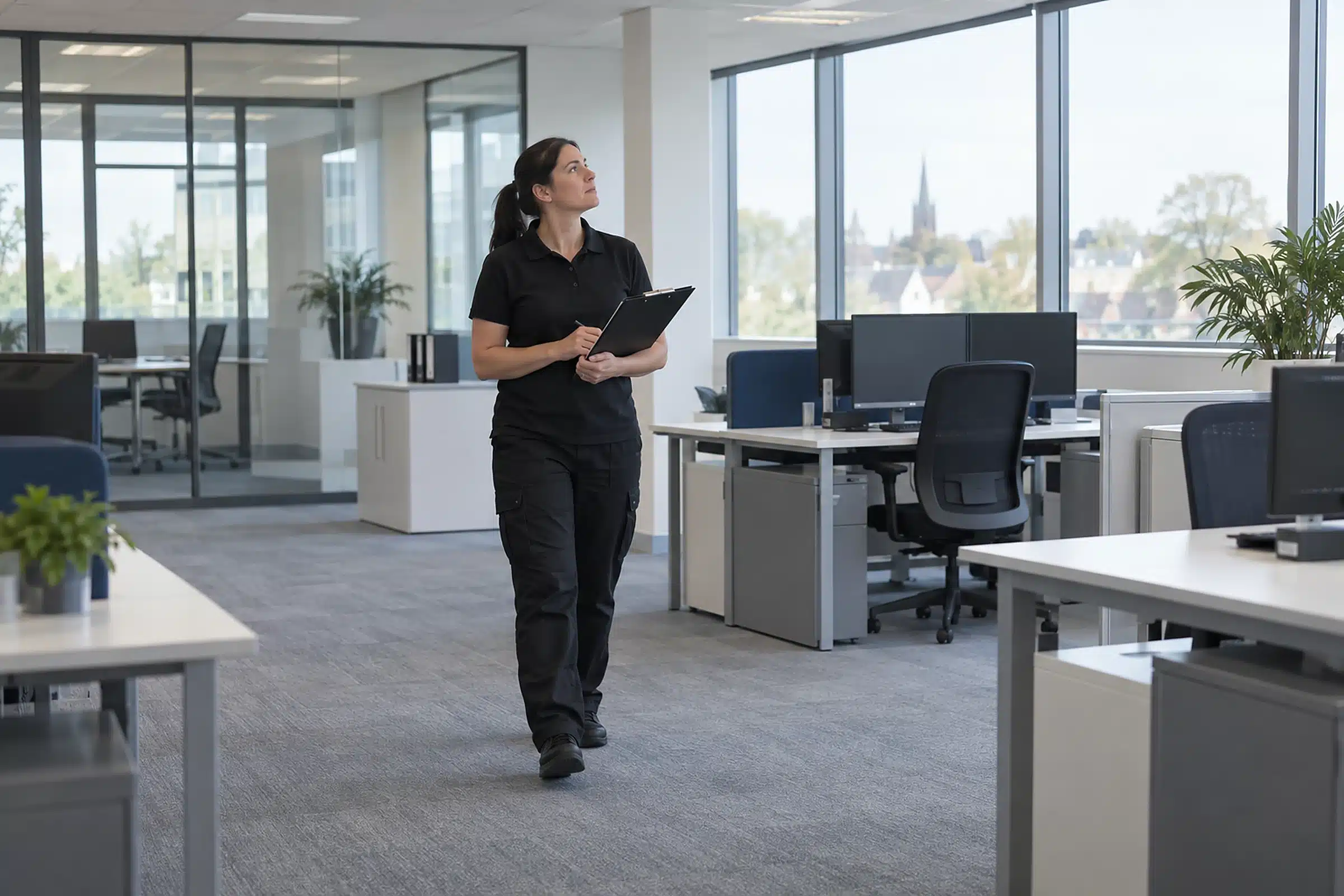
When you bring a cleaning contractor into your building, you are handing someone keys, access and often the run of the place outside working hours. They will be using chemicals near your staff, working at height on your ledges, trailing cables across your floors and moving equipment through your corridors. Most of the time none of that causes anyone a moment’s thought, which is precisely the problem. It is the contractor who has never thought about it either that you need to worry about.
This is what accreditation is for. A CHAS accredited contractor has had its health and safety practices examined by an independent body against a national standard, rather than simply asserting on a website that it takes safety seriously. For a facilities manager, an office manager or a business owner comparing quotes, it is one of the few signals in the whole process that has actually been checked by somebody other than the company selling to you.
What CHAS accreditation actually is
CHAS stands for the Contractors Health and Safety Assessment Scheme. It is one of the UK’s most established health and safety accreditation schemes and a founding member of SSIP, Safety Schemes in Procurement, which is the framework that lets one assessment be recognised across multiple buyers rather than every client running its own.
The important word is independent. Any contractor can tell you it works safely. A CHAS accredited one has submitted its policies, records and procedures to an assessor who has reviewed them against a rigorous national benchmark and approved them. It is third-party evidence rather than a claim, and that distinction is the entire value of it.
What the assessment actually covers
CHAS looks at the systems and documentation that show a business manages health and safety properly across its real areas of risk. To achieve and keep accreditation, a contractor has to evidence things like:
- A written health and safety policy
- Risk assessments and method statements
- Safe systems of work
- Adequate insurance cover
- Staff training and competence records
- Safe use of materials, including COSHH
- Accident and incident procedures
- Equipment and maintenance records
- Ongoing monitoring and review
Read that list again with a cleaning contract in mind and it stops being abstract. COSHH is about the chemicals being used in your washrooms and kitchens. Training records are about whether the person on a step ladder dusting a high ledge in your office has been shown how to do it safely. Insurance is about what happens if something goes wrong on your premises. None of it is paperwork for its own sake.
It is reassessed every year
This is the part that is easy to miss and worth understanding. CHAS accreditation is not a certificate a business earns once and then displays for the next decade. It is reassessed annually, so a contractor has to keep its policies current, its training records up to date and its procedures in actual use, year after year.
That matters when you are comparing providers, because it changes what the badge tells you. A current accreditation is evidence of an ongoing discipline rather than a one-off effort made at some point in the past. If a contractor mentions an accreditation, it is entirely reasonable to ask when it was last renewed.
Why it matters on your premises specifically
Cleaning is often treated as low-risk work, and compared with construction it is. But it is not no-risk, and the risks sit in places that are genuinely yours to worry about.
Chemicals around your staff
Commercial cleaning products are stronger than domestic ones. Used correctly they are perfectly safe. Stored badly, decanted into unlabelled bottles or mixed carelessly, they are not. COSHH compliance is what stands between those two situations, and it is one of the things CHAS looks at.
Work at height and wet floors
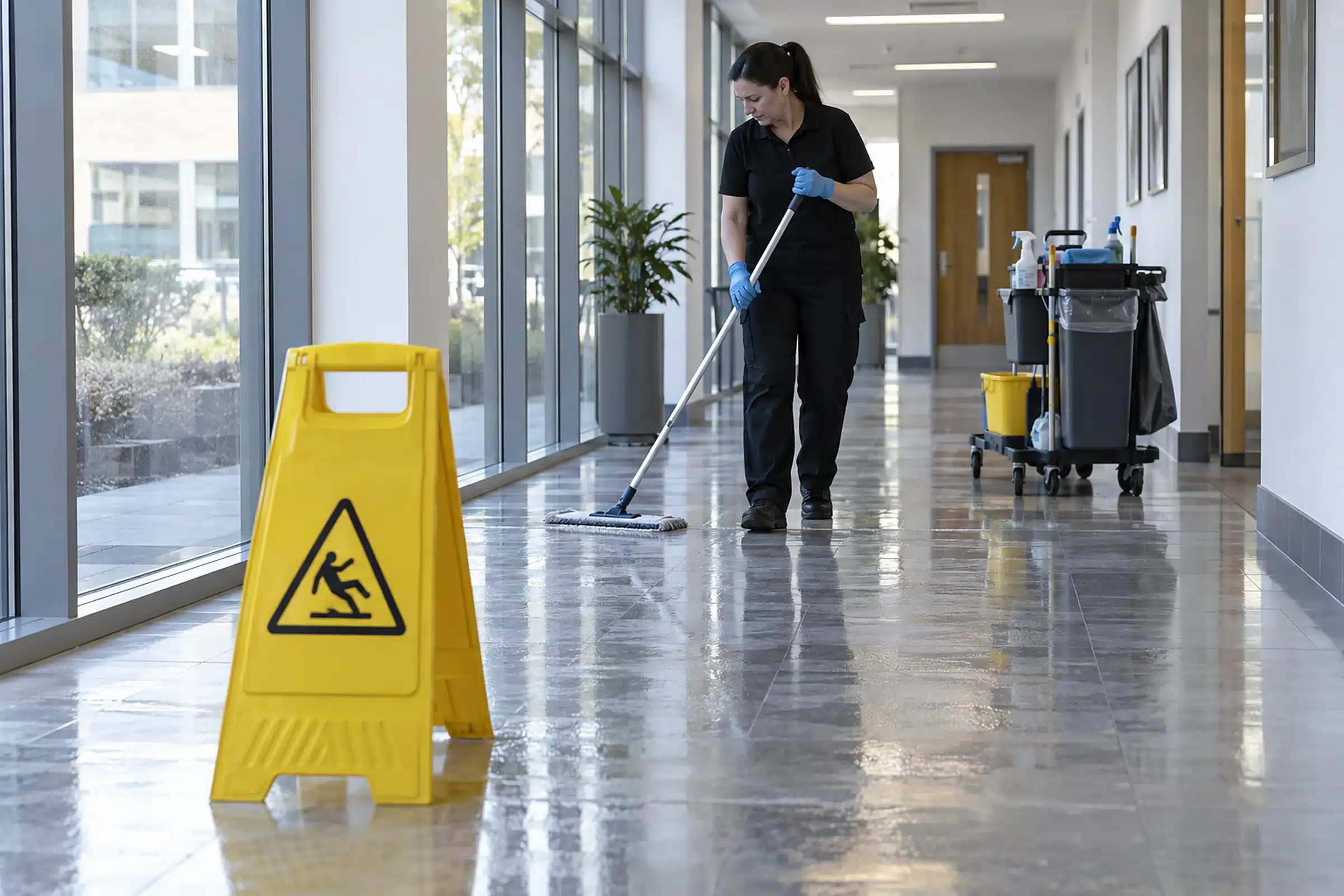
High-level dusting, light fittings, interior glass and the tops of units all involve some form of working at height. Mopping leaves wet floors. Both are ordinary parts of a cleaning routine and both have an established safe way of being done, including signage and timing that keeps your staff and visitors out of harm’s way.
Contractors in your building out of hours
Most commercial cleaning happens early in the morning or in the evening, when the building is quiet and there is nobody from your team around to notice anything. Vetted staff and proper procedures matter more in an empty building, not less.
Your own duty of care
Bringing in a properly assessed contractor reduces the health and safety risk attached to having cleaners working on your premises at all. For facilities and office managers who have to be able to account for the contractors on site, an SSIP-recognised accreditation is a recognised shorthand that does a good deal of that work for you.
How to use it when you are comparing quotes
Accreditation is most useful as a filter rather than a decision. It tells you a contractor clears a bar. It does not tell you the cleaning will be any good, which is a separate question entirely and one you should keep asking.
Used sensibly, it fits into a wider set of checks. Our guide on how to choose a commercial cleaning company covers the rest of them, from how a provider covers staff absence to whether the same team will look after your site. A few practical points on the accreditation itself:
- Ask to see it. A genuinely accredited contractor will produce the documentation without hesitation. Reluctance is informative.
- Check it is current. Annual reassessment means a lapsed accreditation is a real thing, not a technicality.
- Ask what it covers in practice. A contractor that understands its own risk assessments can explain them in plain English. One that cannot has bought a badge rather than built a system.
- Do not stop there. Insurance, references and a proper site visit all still matter, and are covered in our guide on how to prepare for a cleaning quote.
Where it matters most
Some settings make accreditation close to non-negotiable. Schools and education sites have safeguarding and documentation expectations of their own, which is part of why school cleaning is treated as a specialism rather than an ordinary contract. Industrial units and warehouses carry heavier site risks. Premises still in the closing stages of building work bring a contractor onto what is effectively a live site, which is one of the things that makes a builders clean a specialist job rather than an ordinary one.
In an office or a gym the risks are lower, but the reasoning does not change. You are still letting a contractor work unsupervised in a building you are responsible for.
Common questions about CHAS accreditation
Is CHAS a legal requirement for cleaning contractors?
No. It is a voluntary accreditation. The underlying health and safety duties are legal obligations for any employer, but the accreditation itself is a contractor choosing to have its compliance independently assessed rather than simply asserting it.
Does CHAS accreditation mean the cleaning will be better?
Not directly, and it would be misleading to claim otherwise. It assesses health and safety management, not how well anyone cleans a washroom. What it does tell you is that the business runs on documented systems rather than improvisation, and in practice that tends to travel across into how the work itself is organised.
Can I see your accreditation?
Yes. You can read more on our CHAS accreditation page, and the supporting documentation, including risk assessments and insurance, is available on request before you commit to anything.
A contractor you can account for
Welch’s of Wilmslow is a CHAS accredited contractor. Our health, safety and compliance practices have been independently assessed and approved, and that accreditation sits alongside the things we are actually judged on day to day: turning up, holding a standard, and communicating honestly when something needs sorting. You can see the full range of our commercial cleaning services for offices, gyms, schools, retail and industrial premises across Wilmslow, Knutsford, Alderley Edge, Macclesfield, Northwich, Winsford, South Manchester and the wider Cheshire and North West area.
If you would like a cleaning contractor you can put on site without a second thought, we would be glad to help. Call the team on 07834 341056 or request a tailored quote, and we will arrange a visit to your premises.